Showing posts with label Equilibrium. Show all posts

Wednesday, 30 December 2015

2015: stepping up and looking back

2015 is drawing to a close. The world continued to get warmer, the Conservatives won the General Election, the House of Commons authorised airstrikes over Syria, people the world over were killed at the hands of terrorists... It's been an internationally frightening time. Yet, important political campaigns also started, there were also lots of amazing books, films and songs written and made, sporting events I have no interest in happened and people won them, same-sex marriage became legal in the USA and the Republic of Ireland, and scientists made amazing discoveries, including the first new antibiotic in 30 years. And the 'future' also became the past with Back to the Future day. What a year!

So, what have I been up to?

I married the woman I love and we went on an amazing honeymoon to Canada. We got some really bad news. We got some really good news. I sat with someone whilst they slipped out of life. I 'MC-ed' a funeral. I discovered that the reason we keep not having hot water is that the boiler was plumbed in with the pipes the wrong way round. I've taken THOUSANDS of trains, buses and tubes. I've done lots of jobs (old and new). I've made new friends.

Here's what I've been doing in my working life (this can now act as a crib sheet for my wife when I test her on where I work!) - in no particular order:
  • Turning Point - delivering their bi-weekly 'Creative Space' for service users on an Abstinence Day Programme, who are all in recovery from substance addiction. I also recently ran professional training for the staff team on how they could make their sessions more creative, which I'm hoping will be rolled out to other teams in the new year. I got one of my favourite pieces of feedback of the year from a participant at this service the other week who, when 'checking out' at the end of the session, said: "Kate, you don't step back, you step up. And that makes us step up too." Gave me the feels. My other fav feedback that day was: "I thought I was going to fucking hate it and I didn't." 
  • Attic Theatre Company - running weekly Drama workshops for young migrants to help them learn English and make friends, as well as developing communication skills, team work, mutual respect and empathy. I also delivered a week's summer school (for the second year running) for children who are preparing for the move from primary to secondary school, where we designed Drama-based activities to support them with this transition (such as a giant, interactive game I made up loosely based on Snakes and Ladders).
  • Fearless Futures - a new job I started in the summer, as a 'Trailblazer', I first worked on their summer school and then worked with a small group of ten 16yr old girls to discuss gender inequality (locally, nationally and internationally), develop their leadership skills, discuss their aspirations and inspire them to be social activists. It was really moving to read their feedback at the end, as one young woman wrote that she had been being bullied since starting at the school and our work together had given her the confidence to tell her teachers about it. So definitely worth the early starts and three hour round trip to the school! 
  • Equilibrium - facilitating a weekly group at Clarendon Recovery College with mental health service users, supporting them to produce a quarterly online magazine about wellbeing, with the help of our amazing graphic designer, Anthony. Check out our latest issue.
  • 3FF - facilitating interfaith workshops in schools for their education team, including 'The Art of Asking', 'The Art of Empathy', and 'Encountering Faiths and Beliefs', where I facilitate the dialogue between our guest speakers and students; for example we might go into, say, a Catholic school and take a Muslim, an Atheist and a Buddhist speaker, and the students get to ask them questions about their beliefs (I love those sessions).
  • Family Lives - continuing to work on their TeenBoundaries project, delivering Sex and Relationship Education in secondary schools - particularly focusing on sexual bullying, self-esteem, consent, sexting, porn, and healthy relationships.
  • Future Creative - another new job, delivering Drama-based workshops, which has already taken me as far as Lincoln, to run a day of workshops on immigration, and Birmingham, for a Roald Dahl day.
  • Inner Drive - another new one (one can't have too many zero hours contracts), running education workshops drawing on neuroscience to teach young people life-skills.
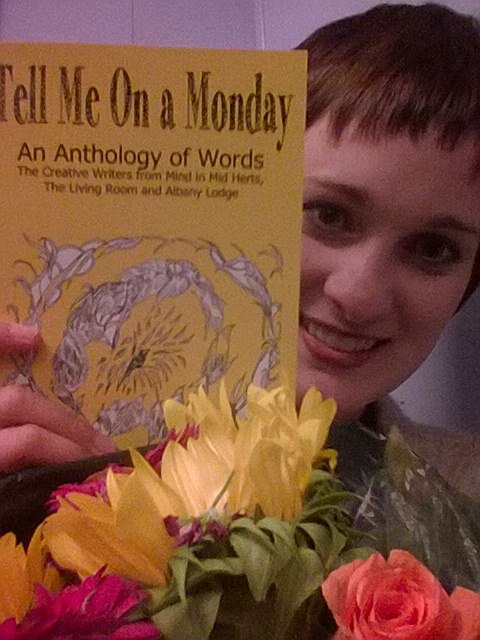
  • St Albans Arts - continuing to deliver Creative Writing workshops in St Albans. The project I'd started in 2014, first working with Mind in Mid Herts and The Living Room, then Albany Lodge (an inpatient psychiatric hospital, which proved a logistically challenging context to work in), culminated in May 2015 with the publication of an anthology of their work, Tell Me on a Monday. Then for the next phase of the project, I delivered 'Write it Out': workshops for people with/supporting people with Parkinsons, in partnership with Parkinsons UK (who are funding me to come back and work with them again in the new year - yay). I also presented at Creative Hertfordshire's 'Art of Wellbeing' conference and did some group writing with the delegates. I'm now really looking forward to working on an Arts on Prescription project in partnership with Trestle Theatre Company in the new year.
  • The Living Room - after delivering Creative Writing workshops there funded by St Albans Arts, I was really pleased to be invited back for two sets of eight more sessions with the service users, all in recovery from various addictions. It's been really interesting working with people whose addictions aren't only substance-based, and has really made me reflect on my practice.
  • Coopers Hill - I've been doing some consultancy in the form of Creative Direction and Partnership Strategy for the lovely Peter Rabbett, supporting the evolution of a new centre for Creative, Digital and Performing Arts at Coopers Hill in Bracknell. It also meant I got to meet one of my educational heroes, Sir Ken Robinson, at the Festival of Education.
    Me and my "new best friend", Sir Ken
  • I've done a few more bits and pieces for the Southbank Centre, including running a two-day workshop for the Festival of Love, in the place of Jodi Ann Bickley (who was unwell), called 'one million lovely letters'. This is a project designed to send 'a hug in an envelope' for anyone who needs one, and so I spent a couple of days helping people write and decorate letters to strangers, old and young, near and far, who might need to know someone out there cares. 
    I also came back for a second year to do some early morning 'speed mentoring' in the London Eye for their International Day of the Girl celebrations, which was again a complete privilege. Watching the sunrise over London, whilst talking to young woman about their ambitions, worries and dreams, might be one of the very best ways to start the day. 
  • Another little, but very moving, work-thing I did earlier this year was for Jennifer Lunn at Culturcated Theatre Company, when I spent the day at Evelina Children's Hospital with three other actors, performing stories the children on the ward had written to them at their bedsides. I got to be a giant bubble floating through the sky, a robot warrior, a naughty cactus, an Elven King, and plenty of other bizarre and amazing characters. It was such a wonderful and inspiring day; I really hope I can go back sometime and do it again. 
  • In May, I made a brief appearance on CBBC's 'Vote for Me', a programme designed to engage children in democratic processes. I was doing a Shakespeare assembly in a primary school in Lewisham. I had a wooden sword. Next stop, fulfilling a life-long dream of being on Jackanory??
So, that was all the paid stuff (I think; I may have forgotten something). As a volunteer, I also did:

    Talking to Yr6s in Lewisham about my wife
  • Diversity Role Models - I've been volunteering as a 'Role Model' with DRM for four years now. They're such an inspirational charity, working tirelessly to prevent homophobic and transphobic bullying in schools. I've only volunteered in secondary schools in the past, but a few weeks ago was invited into a primary school to talk to the young people about being bisexual and my recent marriage, which was super fun and the children asked such brilliant and interesting questions.
One Yr6 child's promise after the workshop
Feedback from another Yr6 child
  • Action Breaks Silence - this is such an amazing charity, working internationally to combat and prevent sexual and gender-based violence. I supported them in the development of their new programme for 7-11 year old boys, designed to build empathy and prevent abusive or violent behaviour in the future. Like them on Facebook if you want to watch the most AWESOME videos of small girls being empowered to kick the shit out of violent attackers!
  • I helped make a Fun Palace in Streatham (and you should all make one where you live too next year!)
  • Female Arts - continued as a reviewer for an online magazine focusing on female creatives
  • Women's Equality Party - I started off as a volunteer Branch Maker (helping set up local branches across the UK) for this new and exciting political party, whose ambition of bringing gender equality to the mainstream political agenda is, I believe, hugely important and well overdue.  I spoke at the Youth Branches' first meeting (you can listen to it on Soundcloud) and am now supporting their education outreach group. I'm also planning on putting myself forward as a candidate for the GLA elections. Watch this space!
I think that's everything!! In other work-related news, I'm currently applying for funding for a PhD, and I'm also co-editing a book with Annie McKean (to be published next year) on the work of Playing for Time Theatre Company in HMP Winchester. I think January is going to be pretty full on.

The new year can be a good time to look back and reflect, as well as look forward and plan (as long as we haven't eaten too much cheese, spent too much time with family, and slip into a 'what am I doing with my life' panic!). Parts of this year have been truly amazing and other parts have been genuinely devastating; we never know what life is about to throw at us (sorry if I'm starting to sound like a motivational fridge-magnet) - so I only hope 2016 brings us some luck, a bit more money (being a grown up can be shit), and I keep getting the chance to work with amazing people in inspirational places. I'm going to keep stepping up...


Tuesday, 23 July 2013

Volunteering with Diversity Role Models

With the next issue of Equilibrium about to come out, here's another one of my articles for it, to whet your appetite!


Volunteering with Diversity Role Models

I first discovered how volunteering could warm your soul in 2007 when I spent a good portion of my week at the Oxfam Bookshop in Winchester, whilst trying to sort my life, health and head out a bit. And it genuinely made a massive impact on me; I felt honoured to be giving my time for free there. It wasn’t completely selfless; in that little bookshop on the aptly named Parchment Street, I made friends, found a sense of purpose, and co-invented our Sunday game: Shop Cricket (and got ‘caught out by Proust’ for the first time).

Now I’m living in London, freelancing my arse off to pay my rent (doing a job I love, though, so can’t complain too loudly) and working for free is something I hoped was consigned to my student days. But volunteering and working for free are two different things: one a social problem of glass ceilings and a devalued sector, and the other an act of giving to a society you want to be an active part of. So when I heard about Diversity Role Models, I knew I wanted to volunteer as a Role Model (hard to say without following the term with some kind of witty, self-deprecating remark, but I’ll resist).    

Set up in 2011, Diversity Role Models is a charity that helps schools to eradicate homophobic bullying and provide an inclusive and safe environment for their LGBT students and families. Through high-quality, interactive workshops involving role models and discussions that allow young people to explore their views and understand difference, DRM hopes to tackle the prejudice that leads to homophobic bullying. ‘I firmly believe that by providing role models for LGBT young people, we can have a positive effect on the negative statistics’, says Suran Dickson, CEO and founder of the organisation, who was prompted to start the charity after witnessing the impact homophobic bullying had in the schools she worked in. And the statistics are shocking: LGBT youth are six times more likely to commit suicide and two thirds of them suffer bullying at school. Furthermore, as they say on their website:

            …it's not just LGBT young people. Straight students are terrified of being called 'gay'.   Girls drop out of sport and boys hide artistic talent to conform to gender roles and avoid being labelled gay or lesbian.

Anyone who’s been into a school recently will know that this is an issue that affects the wellbeing of all young people, whether implicitly or explicitly.

Since its conception, DRM has delivered their workshops to over 5,000 pupils and the results speak for themselves. Over 90% of young people indicated that they would treat LGBT people better and use the word ‘gay’ as a derogatory term less in the future. Teachers and pupils that have attended the workshops have seen a significant shift in attitudes and behaviour in their schools and would urge other schools to seek their help. ‘Fabulous - should be part of the national curriculum! This workshop should be offered to all year groups', enthused one teacher who attended a recent workshop. I know I agree. I am proud to be a Diversity Role Model. The biggest payment is knowing that you’re making a difference. 

diversity role models1
The next academic year will see DRM delivering workshops across the country, as well as continuing to work across the capital. For more information on the workshops and to enquire about booking, contact info@diversityrolemodels.org

Friday, 12 July 2013

Compassion


In anticipation of our Summer Issue of Equilibrium coming out in the next week or so, here's a sneaky peak at my little article on a lecture on compassion. Enjoy (and if you don't, be compassionate and put yourself in my shoes before you comment)...


Compassionate Living, with Karen Armstrong

Sitting in the marvelous Conway Hall on 18th April 2013, I attended my second Action for Happiness lecture of the year (see the Spring issue of Equilibrium for my write-up of my evening with Jon Kabat-Zinn), this time to see the magnificent Karen Armstrong. Introduced by Mark Williamson and Lord Richard Layard, Armstrong’s lecture provided a historical, theological, scientific and cultural exploration of compassion and its fundamental importance to our world.

Armstrong explained how liberty and the pursuit of happiness are a modern ideal, and how happiness often gets confused with emotions like tiredness, hunger, and hormones. In an oxymoronic world of  'must-have accessories' and post-modern pressures, happiness has become something actively sought, yet still elusive; it is a mirage on the horizon.

Armstrong contextualized her ideas on compassion with a scientific breakdown of the human brain’s different parts: the reptilian brain (the deepest and oldest), the mammalian brain, and the neo-cortex. Now, you’ll have to excuse my schoolgirl knowledge of science (blame me not Karen Armstrong if this isn’t right!), but she essentially explained how the reptilian brain is the one that is egocentric: all about me; it is only concerned with the four ‘F’s – fighting, fleeing, feeding and…reproduction(!), and was not designed for an age of plenty. Next we have the mammal bit of the brain, which came next and developed in line with their new needs. So, whereas reptiles laid eggs, which they could then abandon, mammals give birth and care for their young, and they started to learn that they were stronger as a group. Thus we can see the need for compassion starting to creep into the evolutionary process. The last brain-section (I have no idea what to call it!) in Armstrong’s codification of the brain is the neo-cortex, the newest part, wherein we find the ability for rational thinking, where we can stand back from our instinctive drives. She also posited a very sobering idea that, historically, the worst human atrocities – such as Auschwitz and 9/11 – happen when the first and third brains (base instinct and objective thought: what do we want and how can we do it most effectively) are used without the second: compassion for another’s suffering.  

Armstrong suggested that we need to think globally if we want to be happy, that the trick is ‘to live with suffering’, kindly, creatively and peacefully. If we are caught up in the endless prism/prison of the self, preoccupied with our own thoughts, feelings and small lives we can never be happy. Happiness, with the essential component of compassion, comes from 'dethroning yourself from the centre of your world and putting another there'. Author of A History of God: The 4,000-Year Quest of Judaism, Christianity and Islam, Armstrong also brought theology into the debate, reminding the audience that the ‘Golden Rule’ of all religions and ethical traditions is to treat others as you would like to be treated.

In her new book, 12 Steps to a Compassionate Life, she suggests that we exercise compassion through remembering our own pain and refusing to inflict it on others, that we use our own feelings as a guide. This doesn’t mean that we literally treat others as we would like them to respond to us, as it is far more nuanced than that; we need to use our knowledge of that person as well, and not assume that their desires and responses would mirror ours. For example, the sentence, ‘Well, I would have wanted to know’ encapsulates this, as it does not encompass the crucial question: but would they want to? It takes a constant effort of imagination to put yourself in other people's shoes, but is all part of compassionate living (and why I think Drama – active empathy! – should be recognised as an important part of the National Curriculum – but I’ll save that article for another time).

Her allusion to the ‘12 Steps’, commonly associated with recovery from addiction, is no coincidence, as Armstrong suggested that we are addicted to our likes and dislikes, to our need to compare, to bitch even, and to say things like 'the trouble with her is...' – trying to ‘sum up the mystery of a person in a single phrase’. It makes us small, narrows our horizons, and does nothing to aid our own happiness. We need to let go of our opinions and take responsibility for the world's pain. The pain ‘needs to break our heart, so we reach out into the world in compassion’. This sat slightly uncomfortably with me, as I just feel that there is simply too much pain in the world for me to take on – how could I even process it and, if I did, how would my heart ever recover? But I can do my best, and I will sign up to her Charter for Compassion as I do believe we need to make compassion 'a clear, luminous and dynamic force in our polarized world’. Will you do the same? 


Saturday, 11 May 2013

Equilibrium - Spring Issue!

Here's the latest issue of Equilibirum, the magazine on wellbeing I produce with mental health service users in Haringey.


Check it out for a range of articles, including Alyssa's tale of her ridiculously long bike ride and the importance of taking risks, some great reviews, a bit of science, thoughts on Anti-psychiatry and the Hearing Voices Network, and some gorgeous spring photos.

Here's my article on Mindfulness to whet your appetite, or for those too lazy to click the link....


Mindfulness

On 28th March, I joined a staggering 1000 other people at the Friend’s House on the Euston Road for An evening with John Kabat-Zinn. Famed for bringing Mindfulness to the West, 35 years ago, the evening was a celebration and further investigation into this practice: ‘an adventure into the art of conscious living’. The event was run by Action for Happiness, and introduced by their chair, Mark Williamson, an organisation whose prime concern is to take action to try and create a happier world. They do this by looking both outside – calling on political leaders and those with the power to change policy – and inside at the self, in an endeavour to maximise human wellbeing.

JKZ (as I shall call him, for ease) was welcomed to the stage by Lord Richard Layard, the economist – and Labour peer – who made the economic case for IAPT (Improving Access for Psychological Therapy) to the Labour government in 2006. I was thrilled to hear Layard had not only been involved in JKZ’s mindfulness course for parliamentarians (I wish they’d make it compulsory in Whitehall!), but will also be involved in a pilot study to reform PSHE (Personal, Social, Health Education) in schools, including adding mindfulness to the curriculum. But, rather than going off on a tangential rant about the need for cohesive, consistent and relevant emotional and social education in our schools (a matter close to my heart), I shall try and stick to JKZ and mindfulness for the moment – and mindfulness is all about the moment!

Mindfulness – a practice rather than a technique, as it is something you cannot simply learn and store away somewhere, but more a way of living in the world, ideally a way of living that is practised and observed daily – is drawn from the principles of Buddhist meditation, and is essentially the act of being with our experience as it is unfolding, moment by moment. JKZ described it as ‘the awareness that arises intentionally, in the present moment, non-judgementally’. Or something like that – it was quite hard to be in the moment, listen, and frantically scribble notes all at the same time! But breaking it down into its necessary components, it is:

Awareness
This is not ‘doing nothing’, but ‘non-doing’: waking up to the world around us; being present without an agenda

Intentional 
Interestingly, he described it as ‘a radical act to wake up early and take your seat every morning’, particularly in a world where distractions seem everywhere; intentionally being in the moment, rather than the past or future

Present 
Right now, this very moment

Non-judgemental 
He talked about the importance of cultivating an ‘affectionate attention’; ‘putting the welcome mat out for things as they are’

Mindfulness is essentially being fully mindful, physically, emotionally, mentally of the now; my favourite thing he said was ‘Now is the now. Check your watch – it’s now again’. As a group of over 1000 individuals we all came together in a moment of formal meditation, quite early on in the evening, which JKZ instigated by rolling his sleeves up and saying, ‘Let’s arrive’. Mindfulness is complex in its simplicity and very hard to explain in a few paragraphs or pages, and thus actually doing it was important to the discussion. I found myself repeatedly trying to explain it in my head throughout the evening, knowing my partner would ask when I go home what it had been about. And, pre-emptive of her questioning, trying to answer: But what purpose does it serve? And, as I was trying to be mindful, my thoughts were going: Yes, it’s all very nice to have some quiet time, to reflect, but… although, hang on, we’re in the now, aren’t we? So, we’re not reflecting, we’re….what are we doing again? Oh yes, trying not to think. Eek, I’ve ruined it: I’m thinking. And now I’m worrying about thinking. Which is even worse! Arghhh, I’m really bad at this! So goes the mind chatter.

JKZ says: ‘We need to get out of our own way, to the silence underneath and between every sound’. But, as a relative novice, it’s hard not to want to shout: ‘How?!!’ Yet – and as an educationalist, this is something I hold true for many things – he says we should covet a beginner’s mind, the place where we see things newly, freshly, and non-judgmentally. He also repeatedly reinforced that you can’t develop muscles without resistance, so the fact that trying to be a human being, rather than a human doing, is hard is part of the process. And part of why this is a practice, rather than a technique. He used the analogy of thoughts as weather patterns in the mind, drifting across, which is a metaphor I find really helpful, and will certainly use to calm my chattering mind.

I worried that it could be seen as ego-centric and self-absorbed to dedicate that much time to yourself (which is indicative of both my own hang ups regarding guilt over self-compassion, and that I find any talk of ‘cultivating the garden of the heart’ flips my sceptical switch on). But – and really there doesn’t need to be a ‘but’ to justify it, but I’ll slip one in for other sceptics out there – mindfulness looks out as well as in, and is also about ‘being in wise relationship with the suffering and happiness around us’, learning self-compassion and compassion for others. JKZ also highlighted the urgency of it: destruction is woven into our human nature, and we need to take action – radical, sitting down in silence action it may be – to transform the world we live it. And although he told us, ‘You’re fine the way you are’, none of us would be worse for being mindful of the world in which we live, at this moment, exactly as it is and we are. Interestingly, in all Asian languages the word for heart and mind is the same thing; mindfulness is also heartfulness.

If you need more convincing to take a quiet seat every morning and attune yourself to the cosmos, there is also some amazing sciencey stuff to do with epi-genetics, biochemistry, enzymes and things, which I’m probably not clever enough to explain, so you might want to google. Although the crux of it was that daily practice of mindfulness leads to greater emotional balance, caused by more left than right brain activation in the pre-frontal cortex, and greater anti-body production.

If mindfulness is therefore an ‘act of love, sanity and self-compassion’, which has a positive impact on not just my emotional but also my physical wellbeing, and which also builds compassion for others, then I’m sold. And you can do it sitting down – brilliant!